I distinctly remember my first trip to India. I was 19 years old. Fresh out of high school and into university. Not so young yet not as mature as perhaps I thought I was at the time. They say that our university or college years is the period during which a lot of our character and opinions are formed. I don’t know if there is any scientific truth to this hypothesis but on a personal level I would tend to agree.
There were many wonderful memories from that trip; meeting new extended family members, the wonderful hospitality and of course the amazing food. Yet the one memory that is most vivid for me is arriving in India on that first day. Those of you who have travelled there before might be able to relate to this, depending on where you are coming from of course. It is a shock to the senses.
To the unaccustomed, the moment you step out of the airport in India you are hit with an assault on the senses; the seemingly endless tooting and beeping of horns from cars and buses and trucks and auto-rickshaws intermingled with the periodic yell from the lady at a stall calling out “Chai! Chai!”; the bright colours of her saree contrasting with the dullness of the dusty road and building she is setup against; the sweet smell of the tea brewing in her earthen pot mixed with a hint of the pungent spices going in.
The sounds, sights, smells. I loved it.
I will borrow the words of one of my dear friends, John Chapman, who once described it as “order in chaos”.
We were greeted at the airport by Joy, Dad’s cousin or Joy Uncle as he is known. A man with a stature and presence about him which belied a sense of humour underneath, which is perhaps better reflected in his name. After the hellos, introductions, handshakes and hugs, we loaded up our luggage into the classic white Ambassador car and headed out from the airport parking lot.
Joy Uncle was a community leader who lived in a village with his family where he had a farm and rice field and livestock. We were going to stay with him for a few days during this trip and so we drove further out from the city towards the outskirts of town. And it is this point of the journey which I remember with most clarity.
I recall staring out the window, quietly observing the scenery go by. It might have been the introvert in me that kept me silent or perhaps my slight embarrassment at not being able to speak Malayalam! In any case, I simply observed; a church, bullock carts, coconut trees, men with large baskets on their heads, cows, paddy fields, men and buffalo ploughing, women harvesting…
“Why don’t they use tractors or some machinery to work the fields?”, I asked Joy Uncle, breaking the silence.
“What do you mean?”, he responded with a question glancing at me.
“Well you know, modern technology has developed so many tools and machinery that could be used in the paddy fields. Work can be done faster, yield can be produced quicker. Why would you not want to do that?”
Joy Uncle kept looking ahead at the road as he weaved the Ambassador “tank” through the Kerala traffic. I looked at him patiently and thought I detected a hint of a smile or perhaps a grin on his face, obscured by his thick and full moustache. Then he said;
“Yes, you are absolutely right. If we use machines and tractors to plough the fields and plant the paddy and harvest the rice, we would definitely be able to do things quicker and some might say better.”
I felt a hint of pride welling up inside at the wisdom of my recommendation.
And then he paused before looking at me and continuing,
“But to do that, we will need to replace the people who are here. What would then happen to all these men and women who have been working on these fields all their lives? What will they do to earn for their families then? What will happen to their children?”
He kept his gaze on me for a split second longer, thoughtful, and then turned away and continued looking ahead at the road as he drove on towards home, leaving me to ponder the answers to his questions.
I did not have any answers. I looked out the window again, watching the men and women working in the fields as we sped by, thinking about their families and lives. It was 17 years ago. I still think about them today.
—|||—
“We must change the rules of the global economy, for it is the logic of global capitalism that is the source of the disruption of society and of the environment. The challenge is that even as we deconstruct the old, we dare to imagine and win over people to our visions and programs for the new.” – Irene Fernandez, 2005
I have always wondered about this quote by Mum from her acceptance speech at the Right Livelihood Awards in 2005. I tried to understand what she meant by it but always struggled; there was an internal conflict within me. You see, from the moment I left I high school, I have almost always been immersed in a capitalist world. From my university to my professional career, it was all within multinational corporations in an industry that is arguably one of the shining stars of global-capitalism. So I would constantly look back at this quote from Mum and try to understand how and where she saw the faults in this world I operated and lived in. And since I was so caught up in this world, I struggled to see what she meant.
To her credit, not once did Mum ever question my choice of job or industry. In fact, she was constantly supportive and encouraging, although I wonder if that was difficult for her to do. I doubt it; a mother’s love is never conditional or judgemental. But I also wonder if she saw a bigger picture as Mum always would. Perhaps she thought that being in this “opposite” world would open my eyes to her message, whilst always quietly having the confidence and belief that I would eventually find that realisation myself one day. Maybe I’m overthinking it, but if you knew Mum you would know that you could never put that past her!
During this past month, the things that I have seen, the people I have met and the discussions I have had have given me cause to look back once again at this quote from Mum. What has gone wrong with the socio-political and economic system that many of us believe so firmly in yet has resulted in the glaring inequality that we see in the world today? What did Mum see and understand with her incredible foresight all those decades ago? I need to understand this. And not just for me. I believe it is an extremely important question for all of us to explore and try to comprehend especially with what has come to transpire in our world today.
This newly awakened curiosity has led me to start devouring books, some of which I had never considered “palatable” before. From Robert Reich to Karl Polanyi, Arundathi Roy and Joseph Stiglitz, Naomi Klein and Fred Block, Adam Smith and Karl Marx. There has been reading and re-reading, note scribbling, Google-searching, all fed by this voracious appetite and thirst for more knowledge to try and understand the answer to this question. What started as an initial scratching of the surface led to a peeling back of layers and now appears to be a fervent digging to find a deeper truth.
This is unfortunately how I am wired. When I get focused on something that stirs a genuine curiosity or interest in me, I pursue it with an almost maniacal zeal. Whether in my professional or private life, for knowledge or love, it is always the same. It is both a strength and a weakness, a blessing and a curse. Some might be quick to jump to its defence and label it as competitiveness; it is certainly not that, a trait that in my opinion has been given far too much importance and credence in our society. Others might defend it as passion and that might not be an inaccurate definition. Yet passion can be all-consuming. What I will need to learn to do is to harness it in situations where it is useful and rein it in when it can be detrimental.
But I digress.
As I continue to read, learn and write, I also recognize that it is merely a beginning for me. I certainly do not profess to be an expert in politics or economics. What follows is simply a synthesis of my thoughts at various stages of this unplanned journey. Thoughts that have been formulated from my observations, discussions, readings and reflections. In as much as those early adult years in university were a period of germination and sometimes solidification of thoughts and opinions, so now is this period of journeying. There is much to be learnt from travels if we are open and receptive to the teachings all around us. I think about how Che’s “Motorcyle Diaries” formulated much of his ideas and thoughts, polarizing as they may be to many.
To the cynical reader, you have probably raised an eyebrow thinking “Hah! He thinks he is Che Guevara now!”. I assure you I do not. The only thing I share in common with this symbolic revolutionary are the last two syllables of my first name, and that too with a modified spelling.
I do not yet know how these posts will be structured. It is after all more akin to the incoherent ramblings of a musing as opposed to the structured thought-process of a book. As such, it is more than likely that in the process of reading, reflecting and writing I may contradict myself on more than one occasion. I also expect that this series of posts (if indeed that is what they turn out to be) will be punctuated by non-related posts on some other thoughts and reflections at certain points in time during this journey. For this, I apologize to all the ardent followers of my blog, I trust all 4 of you will understand.
I shall end this post with a beginning of sorts. Let us start by reflecting on these two paragraphs from Polanyi’s The Great Transformation where he is discussing the subject of enclosures during the Industrial Revolution which began in 16thcentury England:
Fired by an emotional faith in spontaneity, the common-sense attitude toward change was discarded in favour of a mystical readiness to accept the social consequences of economic improvement, whatever they might be. The elementary truths of political science and statecraft were first discredited then forgotten. It should need no elaboration that a process of undirected change, the pace of which is deemed too fast, should be slowed down, if possible, so as to safeguard the welfare of the community.
“The poor man shall be satisfied in his end: Habitation; and the gentleman not hindered in his desire: Improvement.” This formula appears to take for granted the essence of purely economic progress, which is to achieve improvement at the price of social dislocation. But it also hints at the tragic necessity by which the poor man clings to his hovel doomed by the rich man’s desire for a public improvement which profits him privately.
Read. Reflect. Respond.
The poor man clinging to his hovel…
Once again, my mind goes back to those women and men in the paddy fields of Kerala.
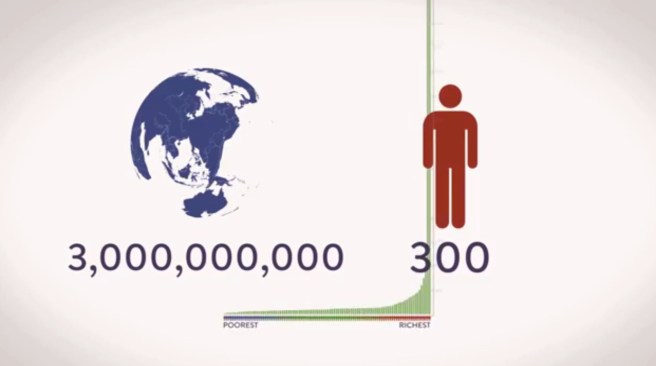
Image: blog.therules.org


